
How do I know if a translator is certified? A “certified translator” is someone who has the right to authorize their translations with a Certificate of Accuracy.
The difference between a certified translation and a non-certified translation often determines whether your documents get accepted or not.
A rejected translation doesn’t just slow things down. It adds to the overall costs.
Your university application may be returned, your immigration case may be delayed by months, you may have to pay resubmission fees – just because you failed to meet all the submission rules.
If you are searching for a “certified Russian translator near me,” find out what to look for in a qualified, experienced professional who will ensure that your documents get accepted the first time.
Before you spend money on a translation that gets rejected, here’s how you can verify a translator’s credentials to make sure you are getting your money’s worth.
What “Certified Translation” Actually Means
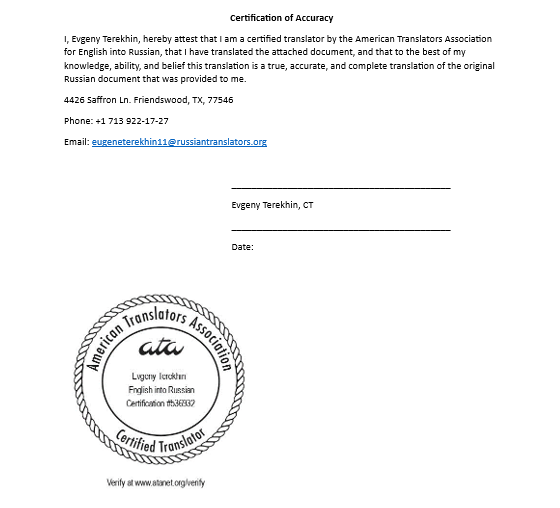
A certified translation is a translation of the original document accompanied by a signed statement of accuracy from the translator – the Certificate of Accuracy.
This written statement confirms that the translation is complete and accurate and that the translator is competent to perform it.
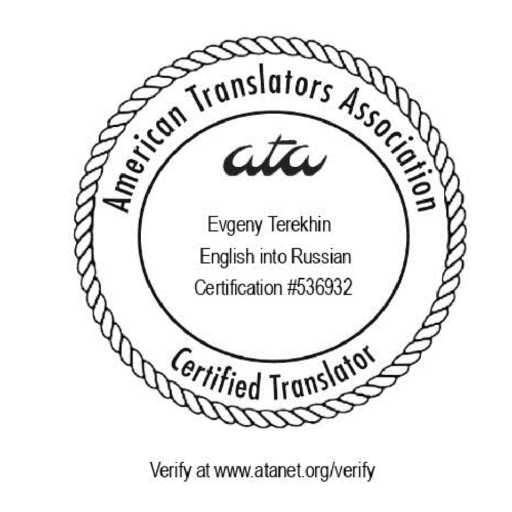
It is also accompanied by the translator’s professional stamp at the end, which contains their certification number and contact information.
That’s it.
In other words, the translator provides a signed letter – a statement of accuracy along with their personal signature and stamp.
A notarized translation is when a notary public witnesses the translator’s signature and verifies their identity. The notary does not read the translation; they only guarantee that the translator signed it in their presence.
USCIS does not require notarization. It only requires a signed letter from the translator to confirm their competence and accuracy. Many people pay extra for notarization when submitting immigration documents, but it’s usually not necessary.
Courts and universities may have additional requirements, but for most filings in the U.S. what is required is a properly signed certification letter.
The Process of Hiring a Certified Russian Translator
ATA certification is the most recognized professional credential for translators in the United States. To earn it, the translator must pass a rigorous exam in their language pair.
- Verify their ATA Certification
When looking for an ATA-certified Russian translator, always ask for their certification number – not their ATA membership number.
These are two different things. You can verify the translator’s certification number through ATA’s official online verification tool. If a translator can’t provide a certification number, they may simply be an ATA member.
- Ask for a Sample Certification Letter
A legitimately certified translation comes with specific information about the translator at the end of the document. At the end of the translation, you should see the translator’s certification letter, their signature, a declaration of competence in the language pair, and a statement that the translation is complete and accurate.
USCIS and most U.S. institutions require a signed certification letter as an essential element. Some translators put their stamp at the end of the document, but the signed statement is all that counts.
Ask the translator to send you a sample certification letter before you pay. Any professional translator will have it readily available.
Potential Red Flags
- An unnamed agency you found online that can’t provide a verifiable translator.
- Prices below $20 per page (which usually means corners are being cut on quality).
Standard Pricing and Turnaround Times
Certified Russian-to-English translation in the United States usually costs between $23 and $40 per page. A standard page is approximately 250 words. If you have more than 10 pages to translate, you can ask for a discount.
Rush fees vary. Standard turnaround time for a 1-3-page document is 24 to 48 hours. Many birth and marriage certificates can be translated within 24 hours by an experienced translator.
Expedited service usually costs 30% more.
Evgeny Terekhin completes most projects within 24 hours, including the signed and stamped certification letter – ready to submit.
Russian Interpreter for Asylum Interviews, Court Hearings, and Depositions
A certified translator handles your written documents. But what if you need an interpreter in the room?
When you are about to face an asylum officer or a judge who will decide the next steps in your immigration case, your main concern is to be understood fully.
You want to communicate your thoughts and feelings as accurately as possible. Yet it can be extremely difficult to concentrate when you feel nervous, tired or both. Having a calm, competent, and professional interpreter to support you and speak on your behalf can make all the difference in the world.
I have served as a certified Russian interpreter at dozens of USCIS interviews, court hearings, and depositions, helping numerous clients express themselves clearly, fully, and accurately.
According to USCIS and EOIR guidelines, bringing an unqualified friend or family member into a formal proceeding involves real risks most people underestimate until something goes wrong.
An immigration interview or deposition is a high-stakes event. You’ve probably spent countless hours preparing your documents, gathering evidence, building your case, submitting paperwork, and consulting with your attorney.
Now that your interview or court hearing is just a day away, your goal is to communicate everything you’ve prepared to the officer or judge. You want to have by your side a professional Russian interpreter who:
- Understands you not just at the level of words but at the level of meaning.
- Helps you communicate clearly when you struggle to find the right words or finish a sentence.
- Is empathetic and conveys your thoughts, feelings, and concerns accurately to the judge.
As a professional Russian interpreter for USCIS interviews, with over 30 years of experience, I provide both in-person and remote interpretation for asylum interviews, immigration hearings, and legal depositions, serving clients in Houston and across the U.S.
It is highly advisable to have the same professional handle both your document translation and your interpretation because it removes many layers of potential risk.
Why Experience and a Proven Track Record Matter More Than Price
When it comes to hiring a certified translator or interpreter for your immigration needs, a cheap route can turn out too costly.
If your translation gets rejected, you will end up paying more than the cost of a fair-priced one that goes through smoothly the first time.
A lower price involves its risks. The difference between cheap and fair may be just a hundred dollar, but the real question is whether you can afford a rejection.
I have been translating and interpreting between English and Russian since 1993. Over that time span, my work has been accepted by demanding institutional clients including USCIS, federal courts, and major academic institutions.
Every certified translation from Evgeny Terekhin includes a full acceptance guarantee for USCIS, court, legal, and academic use. If a submission is rejected due to a typo or translation error, the issue is corrected at no additional cost.